Florida Design Style Explained

I just got back from ten fabulous days in Florida, most of them were spent luxuriating in Key West, but we also spent a few days in West Palm beach at my mother’s home.  I’m not going to lie, I still want to be there while having my work here, it may take me a while to figure out how to get our owners to move to Key West!

On that note, I have previously discussed Coastal Design, and on my trip I noticed that the overall design style in Florida is much different than that up the upper coast.  Florida design is much richer and heavier, it’s more refined and less beachy.  There is a classiness to Florida design as if old money met modern design, whereas Coastal design is more comfortable like a fine leather that is perfectly broken in.  While they are vastly different, neither is better than the other in my opinion.

Where you will find dark hardwood floors in Coastal design you will find marble or travertine tiles in Florida.

Where you find muted beach tones in Coastal design you will find the colors of nature that are bright and vibrant.

You will find architectural lines and fine details that make bold statements.

Florida design also takes nature and finds a way to turn it on its head!

This design style is lush and takes pride in bringing the outdoors in.  You will find vivid green ferns, palms and orchids placed throughout the home.  No space is off limits when it comes to tropical plants in Florida!!

Would you have this style in your home?

Happy Friday and have a wonderful weekend! ~Andrea

Art Nouveau Design Style Explained

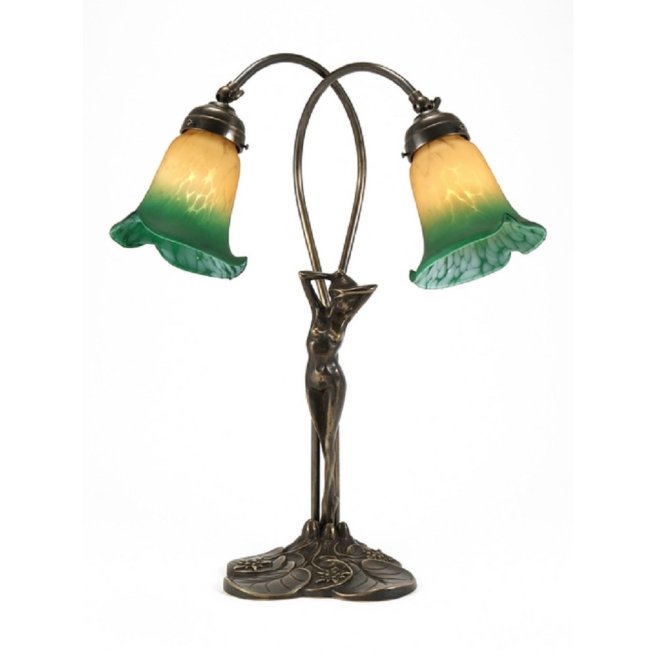
If you love nature, then Art Nouveau is the style for you!  This design style is all about the natural elements from plants and flowers to the flowing curvilinear line of trees.  Popular at the turn of the 20th century (1890-1910) tied in with America’s obsession with European culture.  Art Nouveau dominated everything from textiles and lighting, architecture and interiors, to graphic design, art and advertising.

To get the look:

The prominent focus of Art Nouveau are the curvaceous lines.  Incorporating a few of these into your home will give a strong feeling of this design style.

“Floors – are parquet and should be stained and varnished. (Mosaic tiles in fluid shapes also work very well to convey the Art Nouveau concept.)

[Color] schemes – are quite muted and [somber] and became known as ‘greenery yallery’ – mustard, sage green, olive green, and brown. Team these with lilac, violet and purple, peacock blue. Mackintosh experimented with all-white interiors. Walls – can either be painted in one of the [colors] of the palette or off-white, or papered. Wallpaper – designs are highly [stylized] flowers, particularly poppies, water lilies and wisteria; branches, tendrils, leaves, stems, thistles, pomegranates; peacock feathers, birds and dragonflies.


Tiles – use in panels and intersperse patterned ones with white. A technique called tube lining was used to make the design stand out from the surface – think of piping icing on a cake.

Furniture – Mackintosh is renowned for extremely high-backed chairs in glossy black lacquer. If that’s not your style go for curvy shapes upholstered in a [stylized] floral fabric.

Stained glass – panels went in doors as well as furniture – wardrobe doors, cabinets, mirrors etc, with curved leading for the stalks and leaves, ending in a flower made from pearly enamels or semi-precious stones such as amethysts.

Lighting – you’ve got to have a Tiffany lamp – the beautiful umbrella-shape rainbow of favrile glass with bronze and metal latticework. Original ones cost the earth but most of the high streets stores produce very good imitations.”Source

classic-british-lighting-elizabetta-art-nouveau-female-figure-antique-brass-table-lamp-p2645-4184_zoom


Have a great weekend and happy designing ~Andrea

Shaker Design Style Explained

Function, function, function…this is the mainstay for Shaker interior design style.  Everything needs to have a function (and only then can form follow) ,and because of this, the beauty is almost dismissed.  What ends up coming from the focus on function is a simplified beauty all its own.

shaker-dining

The Shakers came to America in the 18th century, and due to their celibate lives (note the single beds), their numbers reduced over time.  Currently, there is only one active Shaker village remaining in Maine.  The Shakers prided themselves on quality and hard work, as such this is one reason their furniture style has lasted so long.

From their ladder back chairs to peg walls and clean lined cabinetry, all of it has stayed with many carpenters and furniture makers for generations.  Thankfully, there are plenty of them who have studied the Shaker style and techniques.  When implementing the Shaker style to your own place you may first be drawn to Shaker cabinetry.

Kitchens are very clean in this style, with little to no wall mounted cabinets.  The Shakers tend to use shelving to help with the open feeling of the home.

You can also look to incorporate things like a concrete farm sink.

OLYMPUS DIGITAL CAMERA

But, don’t overlook the peg wall and the thought of hanging chairs or other furnishings.

fbab84411f7138169c969b6402aeebef

Use very light neutral colors that can bounce natural light.  Additional lighting is very simple with no adornments.

19

What do you think of the Shaker style?  Do you feel like something is missing?

Take care and have a great weekend ~ Andrea

Steampunk Design Explained

Metal, gears and wood meet a combination of Victorian and leather, throw in dark and rich colors and you have Steampunk.  Many find the dark and brooding interiors of steampunk designs to be very heavy, but for me there is a spark that is lit when seeing this design.  There is an air in these designs that speak to inventions and creation, much like that of the Victorian and Industrialization eras.  (Think of the more recent Steampunk movies like Wild Wild West, Hugo, The Time Machine and any Sherlock Homes movie.)

One of the great things about steampunk style is that you can add a little here and a little there and it’s not so overwhelming.  Steampunk is the ultimate in the mix of modern and refurbished.  So many things in this design style come from tossed out and imperfect items, and rust isn’t a bad thing here.

Oh, and Edison bulbs.  How I love Edison bulbs.  Maybe this is why I really enjoy steampunk!  It’s the ease of which Edison bulbs are incorporated and how natural they look in this setting.

Machine-Age-Lamps-l

Steampunk design fits well into almost any house style from modern or loft to traditional (or my favorite) Queen Anne.  The style can be bright and airy or it can be moody, it is really up to you!

This design style lends itself nicely to those DIYers who like to dig around local junk shops.  There are tons of links for Steampunk projects, like this one for a cake stand.  Or try out this link to learn how to make the bookshelves you see below.


Have a great weekend! ~Andrea

Retro Design Style Explained

When people think of or describe “retro design” it’s the 1960’s interior style that often comes to mind, but according to the definition of retro (imitative of a style, fashion, or design from the recent past) this design style could be a reflection or representation of styles anywhere from the 50’s through the 90’s.

There is a high likelihood that a retro interior will be flirting with the eclectic design style as many Retro pieces will combine with other styles such as modern, transitional, Industrial and even Arts and Craft.

14bf4467335912a0e608741b3ada2bb8

Pryor to 1960 you will see a softer side with curvilinear lines and pastel colors.

In the Retro style after 1960 you will find bold lines, bright colors and amazing graphics that are often used as focal point art pieces.  The 60’s and 70’s take quite a few ques from the Bauhaus movement.

While the 80’s look back to Art Nouveau with its fluidity and soft color palette.


When you need help creating your own Retro masterpiece, let us know!! ~Andrea

Transitional Design Explained

So, what is transitional style? This is what happens when traditional styling is married with contemporary lines.  Transitional styling can fit in almost any type of home from traditional Colonial to modern.

Neutral colors are the base of this style and relies greatly on texture variances rather than color to create contrast.  In the pictures above you can clearly see that the prime elements are texture to include various stones, fabrics, and woods.  Yet, each image uses a very simple color palette.

Light or dark, heavy or light, but always simple with clean and classic lines:


The best part about a transitional style is that as your tastes change, you will have classic pieces which can be used almost anywhere and mixes well with almost all other styles.


Have a great weekend ~Andrea

Tuscan Design Explained

Many years ago my family had the opportunity to spend 14 days in Tuscany.  I was 15 weeks pregnant with my twins and very sick.  It was advised by my doctors that we not take the trip :(.  Fast forward almost 13 years, and though I don’t regret not going on the trip, I do look forward to the day I will finally be able to scratch Tuscany off of my bucket list.  There is something so warm and comforting about the Tuscan design style; it’s almost as if being hugged by a luxurious Sherpa blanket.

83749e6492e22b455bf80a64726f0a42

The biggest defining characteristic is rustic with natural limestone and exposed, natural beams.  Weather worn wood furniture that has been naturally distressed over the years.

Secondarily there is a refined, yet comfortable, elegance that has its style derived from the ornate Italian décor.

You will often find thick wool based fabrics or worn leather on sofas.

Wrought iron balusters and light fixtures are a lighter touch that complement the large and heavy beams.

Colors are the most natural in this design style with lots of browns, oranges, and muted greens.  Take your color cues from the Tuscan country side.

Ultimately, one of the really great things about Tuscan design is that it can be as heavy or light or as simple or ornate as you desire.


Take care and we hope you find inspiration in today’s post ~ Andrea

Asian Design Style Explained

So much of our daily lives are hustle and bustle and wouldn’t it be lovely to come home to a simple and serene place after a hard day’s work.

Asian design style takes its cues from Chinese, Japanese and Indian cultures.  For the most part, the major portions of influence are of Oriental nature.  Quite often you will see Oriental décor placed in modern spaces.  However, what I love most about the Asian design style is that it can easily fit within modern, transitional or even traditional homes and spaces.  A little can go a long way.

Colors in Asian design are based off of nature with bold jewel tones.  Gold is a wonderful accent that often amplifies the brightness of the Oriental colors.  In order to pull off the colors we suggest that you begin with a very neutral palette of whites, tans or grays.

Texture is another staple within Asian design.  I love that texture is incorporated through natural elements such as bamboo, rock, and water features.  You can easily add a rock wall, bamboo flooring or even a Koi pond indoors or outdoors.

Lastly, balance and symmetry are extremely important in Oriental styles.  Creating balance between textures and colors are what truly brings the elements of this design together.


Have questions about a design style that you love?  Feel free to ask us!

Have a wonderful weekend ~Andrea

Art Deco Design Explained


Happy Friday!

Art Deco was a design style that originated around 1925 and lasted through the 1940’s.  Oftentimes, when you do an image search for Art Deco you will also see Art Nouveau images.  The two are not to be confused.  Art Nouveau is very floral and plant based with lines taken straight from nature.  Art Deco is purely the opposite.  Art Deco was the epitome of modern upon its arrival on the 1920’s scene.  It took bits and pieces of previous design, turned it on its head, and introduced a new culture and movement.  Many famous landmarks such as the Chrysler Building, Empire State Building and the Cincinnati Union Terminal all employed Art Deco features.

Art Deco can be described by its geometric shapes and fluidity that rests in sharp contrast to Art Nouveau.  Cheaper plastics, veneers and chromes were used through mass production facilities.  This, in turn, made furniture cheaper for those suffering through The Great Depression. Waterfall Wood furniture (below) is a great example of cheaper mass produced Art Deco furniture.  Because the production was rather cheap there are few “great condition” pieces around.

waterfallfurniture1a.jpg

If you love this design style you can easily incorporate elements to give your space an Art Deco flair without going too far.  Look for simple tub/barrel/club chairs as shown in the living room below.

hqdefault

You can incorporate shapes and/or color too:

This slideshow requires JavaScript.

Have fun with the incorporation and if you get stuck, remember that you can always hire a designer to get you to your desired end result!

Take care and have a great weekend ~Andrea

Eclectic Design Explained

Fabric

Though the eclectic design style is not for everyone there is however, a little eclecticism in nearly every home.  One definition speaks about eclecticism as “not hold[ing] rigidly to a single paradigm or set of assumptions, but instead draw[ing] upon multiple theories, styles, or ideas to gain complementary insights into a subject, or apply[ing] different theories in some cases”.  Almost every home has a few things here or there that really describe who they are, what their family believes in, or may show their cultural preferences.

eclectic-10

This is not to mean that an eclectic space does not utilize basic design principles.  You will see a variety of fabrics and colors and these are best used if they stay within a tertiary color pallet.

tertiary_wheel

What I especially love about an eclectic design is the color that can be used.  So much color!!  Many spaces start with a white or gray base and then the tertiary color pallet is built from there.  The furniture is often a blend of older, traditional, styles and newer, modern, styles.  Begin with a piece that you love and build from there.

Living-room-with-vintage-and-modern-touches-600x398

We here at Onesta Construction hope that you had a wonderful new year ~ Andrea